Blogs
Thermocouple: Structure, Working, and Applications
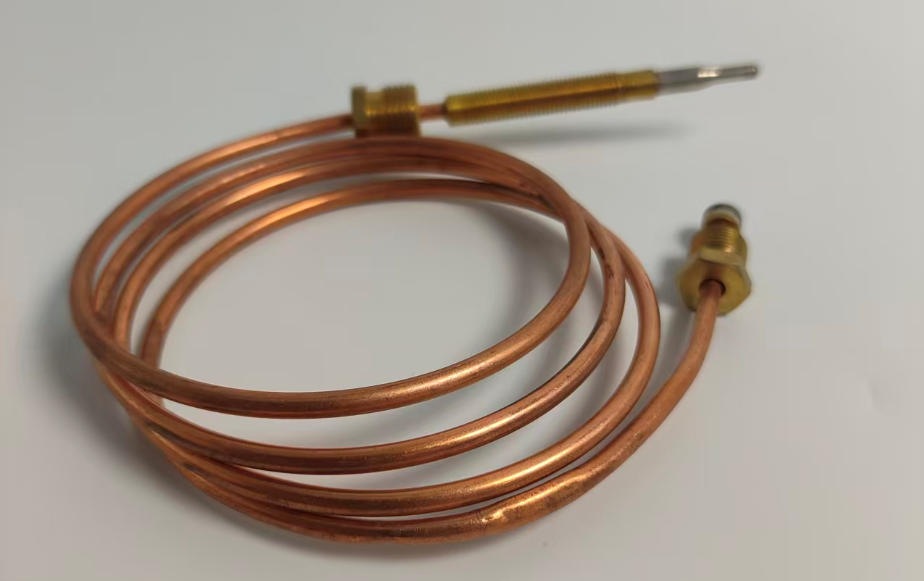
Gas thermocouple: Structure, working Principle, and Applicaitons
A gas thermocouple is a critical safety device found in millions of homes worldwide, serving as the silent guardian in gas appliances such as water
heaters, furnaces, and cooktops. This simple yet ingenious sensor prevents dangerous gas leaks by ensuring that gas flows only when a flame is present.
● Structure and Materials
The construction of a gas thermocouple is elegantly simple. At its core, it consists of two dissimilar metal wires joined together at one end, known
as the hot justion. This juntion is housed within a probe that sits directly in the pilot flame. The outer sheath is typically made of stainless steel or a
nickel-copper alloy like constantan, providing durability and resistance to heat blistering.
The other end, called the cold junction, remains unjoined and connects to the gas valve's electromagnet through an insulated wire inside the metal sheath.
Common materials include copper and nickel alloys, chosen for their thermoelectric properties and electrical conductivity.
● Working Principle
The thermocouple operates on a fundamental physical phenomenon called the seebeck effect. When the hot junction is heated by the pilot flame,
while the cold junction remains at room temperature, this temperature difference generates a small DC voltage-typically between 25 to 30 millivolts.
This tiny electrical current flows to an electromagnet in the gas control valve. When energized, the electromagnet holds the valve open, allowing
gas to reach the pilot and main burner. However, if the pilot flame extinguishes due to a draft or interruption, the thermocouple cools rapidly. The voltage
generation ceases, the electromagnet de-energizes, and a spring immediately snaps the gas valve shut. This fail-safe design ensures that unburned
gas cannot escape into the home, preventing potential explosions or asphyxiation.
● Common Applicaitons
Thermocouples are predominantly used in appliances with standing pilot lights-a small, continuously burning flame that ignites the main burner
when heat is required. These include older gas furnaces, water heaters, gas fireplaces, and some cooking ranges.For appliances requiring more
power to operate thermostats or multiple valves, a thermopile is often employed. This device consists of several thermocouples connected in series,
generating higher voltages from 250 to 750 millvolts.
● Limitations and Maintenance
Thermocouples have a finite lifespan due to the constant heating and cooling cycles that stress the metals. The most common symptom of failure
is a pilot light that will not stay lit after releasing the control knob. Soot buildup or misalignment away from the flame can also prevent proper
operation. Regular maintenance includes ensuring the flame envelops the upper 1/2 inch of the probe and keeping the tip clean for reliable performance.
CATEGORIES
LATEST NEWS
CONTACT US
Name: Aaron Choi
Mobile:+8615669220350
Tel:+8657488094903
Whatsapp:8615669220350
Email:sale2@propanefitting.com
Add:No. 315 of Zhenshi Rd. Jiangshan Town, Yinzhou District, Ningbo 315191, China